Bootload.app failed, but it wasn't a waste
Get new posts by email. No spam, just an email when I publish something new.
TL;DR
- Early on, all that matters is whether your product creates a "magic moment". Without one it's only incrementally better, and nobody notices a new product with no distribution.
- Bootload, a full stack app builder over MCP, flopped when I demoed it: building an app from a chat box is par for the course now.
- It was also too generic. Early products need a handful of users to feel it was built for them: a corkscrew, not a Swiss Army knife.
- I've shut it down and am building a narrower version inside TaskAgent (Files, Tables and Apps), where the magic moment is that the apps you build can talk to all your agents.
Part 1 - what I look for in new products
At the beginning of building a product all that really matters is whether you can create a Magic Moment for a customer.
A magic moment is where you get a spark of excitement from using the product. Something unexpected, that captures their imagination, or that they didn't think was possible.
I would rather a crap product that has a magic moment, rather than a feature rich product that lacks one. The former has potential, the latter is in search of potential.
The risk of not having a magic moment is that it indicates your product is only incrementally better, but not 10x better. A 10% better product is a fail, unfortunately, at least in the software space.
The issue with an incrementally better product is no one pays attention, and since you're new you have zero distribution. Distribution is the key to success in startups, and you see so many cases of a worse product winning simply because they built a community, a following, and a superior distribution channel.
One way to grab people's attention in the sea of noise out there is by making it cool enough to have a magic moment, making it memorable and forgivable for all its flaws.
Where Bootload didn't work
First, what Bootload was. It was a full stack app builder over MCP. A single Rust binary that managed git, the frontend, the backend, and all the builds and runs, from within the one binary. You didn't need anything on your computer. Just a Claude chat box with an MCP connection, and you could build and ship a real app.
Bootload took 1 week straight of agents iterating on it, and the concept felt solid. The magic moment was to be able to create an app using just Claude Chat.
I played with Bootload myself for a few weeks after it was built, but I'm not the target customer as I just use Claude Code.
So I demo'd it at a meetup group, and unfortunately it was a flop.
- "So it's just Codex Sites?"
- "Uhhhh, yea I guess so"
It was a fair point. There are plenty of other products out there that do this, so what is special about this one? Seeing a site come to life is par for the course these days, even if you add on a backend (an incremental improvement from a non-tech user's point of view). So this was not a magic moment for people.
Also, I had such a completely full-featured product, making it super generic and targeted at nobody. This is actually a bigger problem than people realise.
In the early stages of a product you need a small handful of users to feel like this is for THEM, and a generic product is the opposite of that.
If you love wine and need to unscrew some corks, do you buy a Swiss Army knife? Or do you buy a good corkscrew? You go the corkscrew. It has just what you need. A Swiss Army knife does 10 things poorly, a corkscrew does 1 thing well.
Where I'm going instead
I have shut down Bootload, and instead am looking to roll something inside TaskAgent.
I have a use case: my dad wants a coffee roasting app the staff can use. It will be much less feature-rich, but it will just be able to build a little site with a small data store.
The magic moment here is different. The little app you build can talk to all your agents.
You can immediately grab an agent and go "review all the data in the coffee roasting app this week, pump it into these documents, and send a report every week to everyone".
This will be a true magic moment, as it's going to be the first taste the average business owner will have of a fully integrated environment. The apps they build will (through task-agents) talk to their emails, their files and drives, their spreadsheets and even their customers.
I think this will be an "aha" moment, and my ambition is to turn this into an Operating System that eats all software for small businesses. I want to be the OpenClaw that is actually secure and simple enough for the average business owner to use.
Naturally, I have 14 coding agents running to build out 3 simple features for TaskAgent:
- Files
- Tables (for data stores)
- Apps (custom apps that talk to tables and files). These will be created over MCP from people's own Claude subscriptions.
- Synthesise, so task-agents can talk to all 3.
Here's where it's at
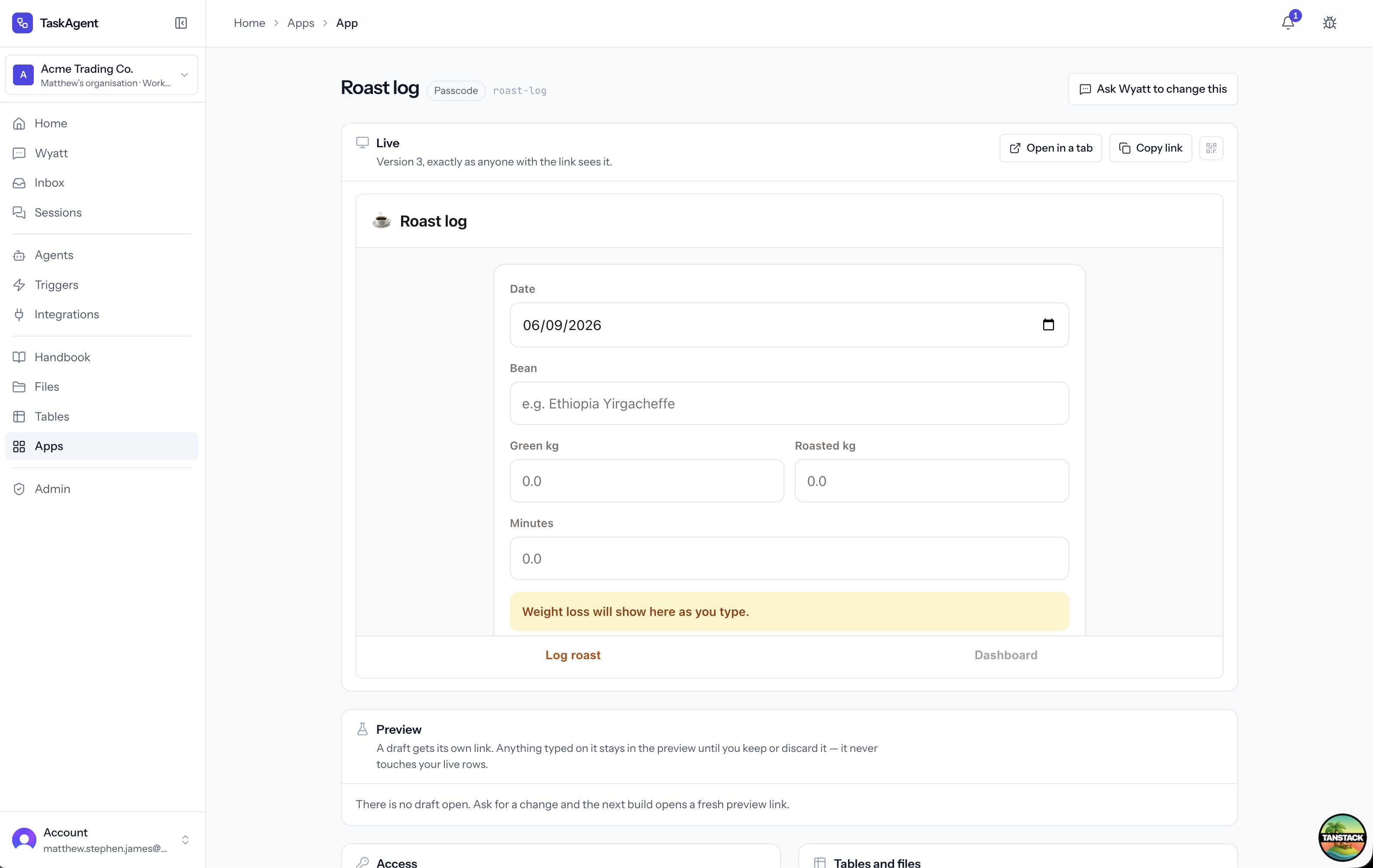
The roast log app, live, with the form the staff will fill in:
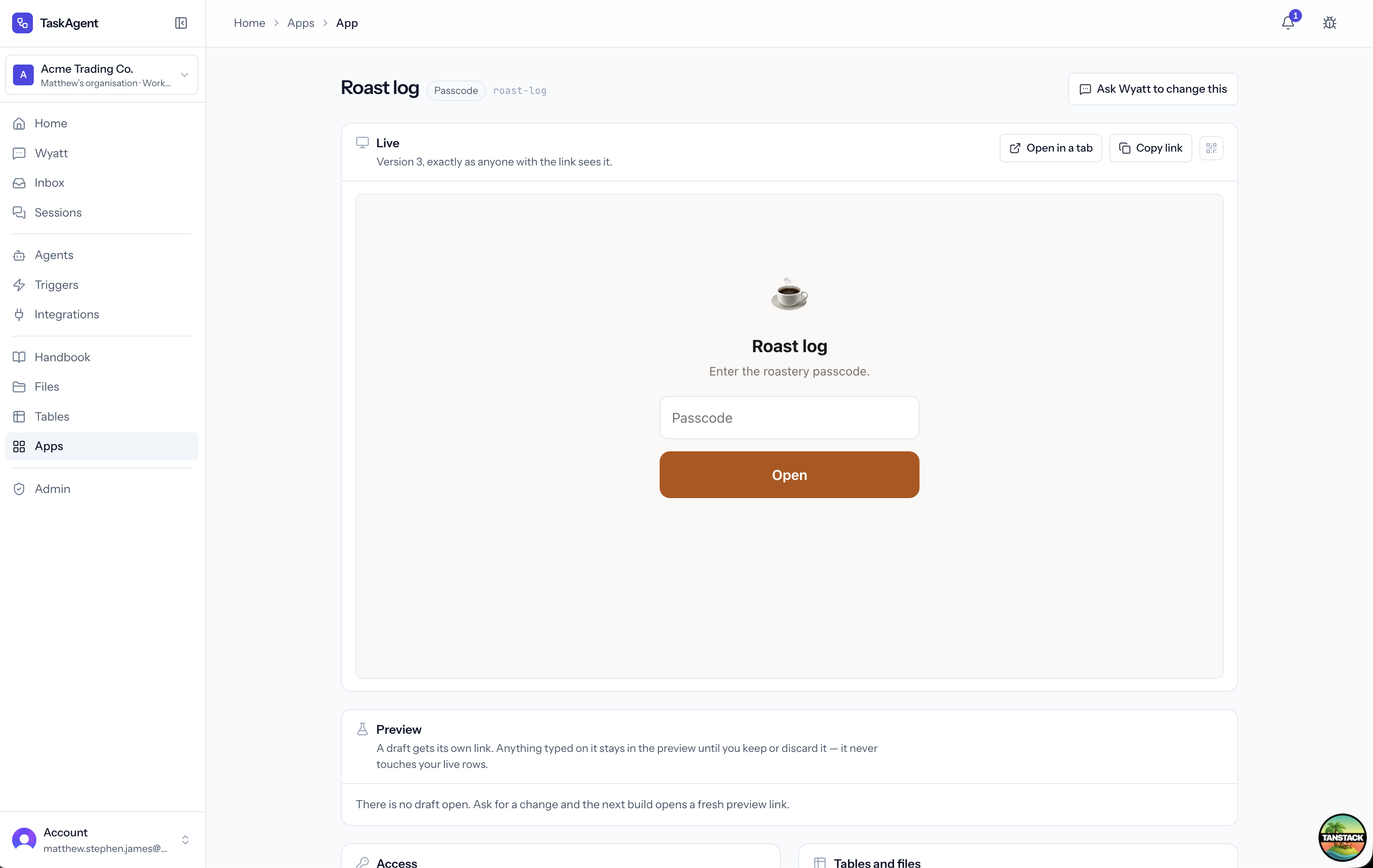
The same app behind a shared passcode, so the staff can open it on the roastery tablet without an account:
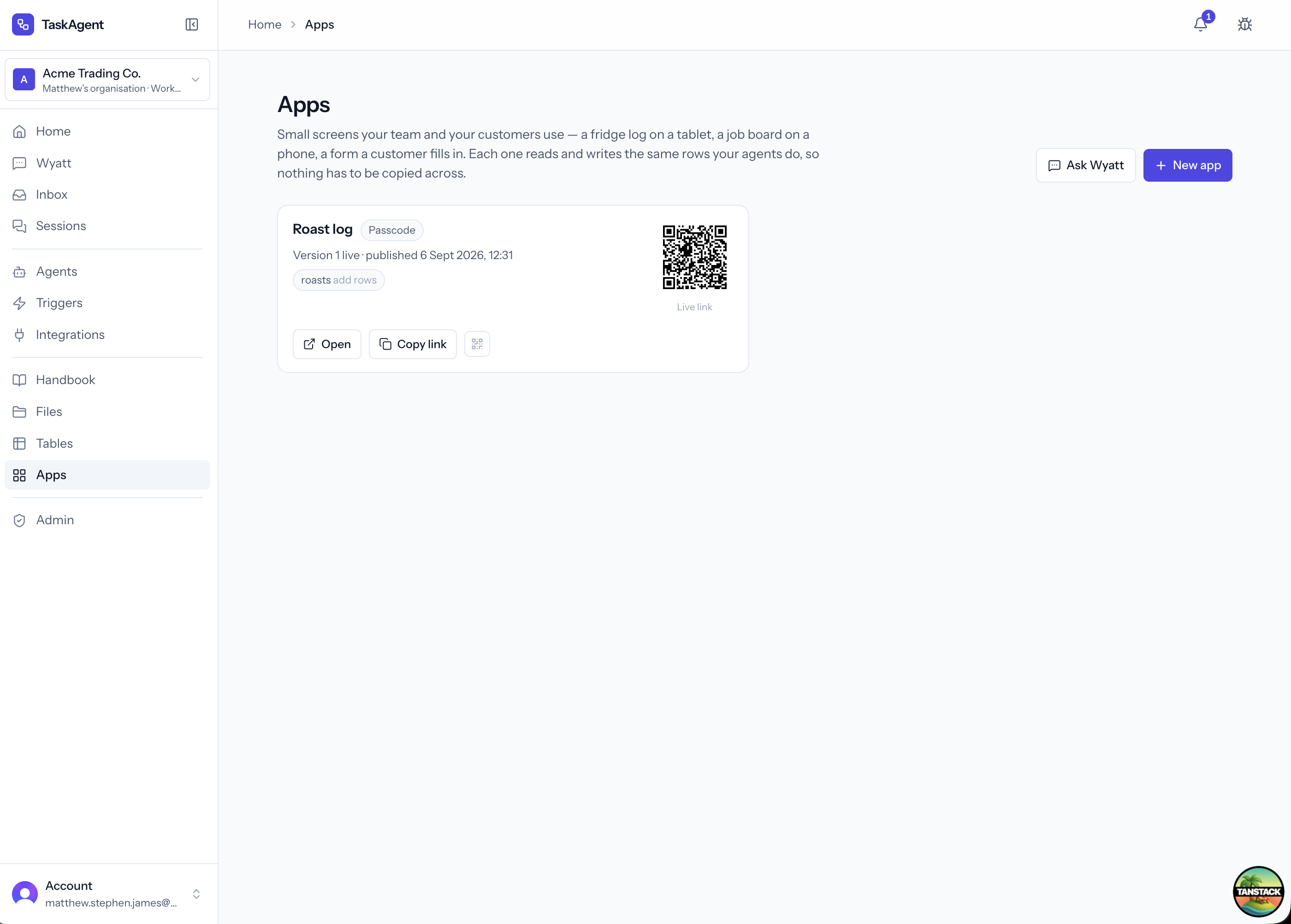
The Apps page, with a QR code for the live link:
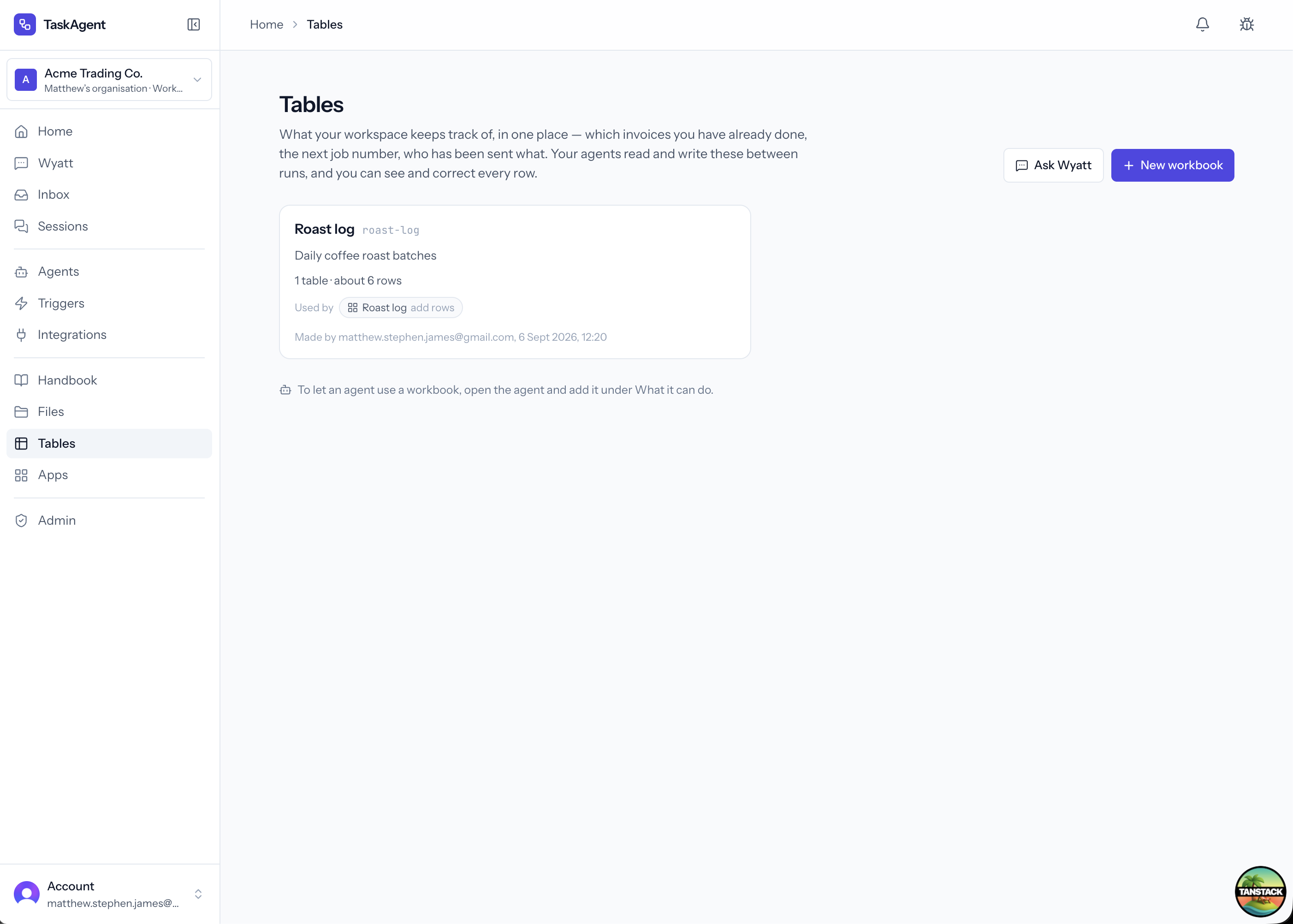
And the table it writes to, which the agents read from: